
The plastic injection molding industry increasingly demands extremely high quality standards and requirements for companies to operate on a global scale in a continuously growing market.The design and manufacture of molds also follows that it is necessary to meet more stringent requirements on delivery time in addition to technical requirements such as short pressing cycles, uniform product quality,...
Table of Contents
Moldflow - Mold Analysis
The working environment of plastic injection molds always has to meet harsh environments in terms of heat as well as mechanical properties, so it is extremely important to simulate and analyze the design from the very beginning to be able to identify design errors. potential design, giving reasonable parameters for the design that can be costly in trial and error.
This leads to optimal design from the start and important parameters are considered for mold design very early in order to benefit both production and later use.
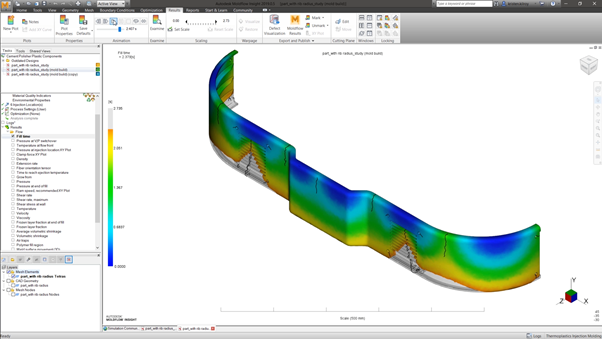
Mold Analysis with Moldflow
PowerMill - Machining efficiently
After the mold design process is complete, the important thing now is how to machine the mold parts in the most accurate, fastest and most efficient way. The above requirements need a combination of many factors that can be calculated such as:
- Quality of machinery for processing mold details.
- Machinist's skill in programming, choosing suitable running ways on CNC machines
- Reasonable technological process to ensure both quality and accuracy while saving costs
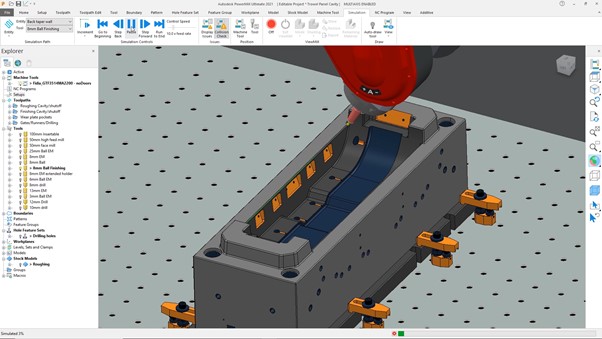
Machining efficiently with PowerMill
Focusing on the part that can be improved the fastest is optimizing the toolpath on the CNC machine, making the most of the machine's capabilities, especially multi-axis machines. With rotating and tilting axes, the tool holder length can be significantly reduced, reducing machining vibration and consequently increasing the surface quality of the product.
Especially when using PowerMill software, the Dynamic Machine Control feature allows users to select the appropriate toolpath before creating the toolpath and also easily edit it even after creating the toolpath to ensure the correct toolpath. The tool is always optimal when machining on the machine. Thanks to the ability to simulate and check collisions on the software, it saves a lot of time waiting for editing, ensuring safety in the production process.
PowerInspect - Mold Components Inspection
To control the accuracy and quality of the product after machining, we can use measuring tools and CMMs to ensure that the product is exactly as the 3D design. Not only used for CMM machines PowerInspect with On-Machine Verification (OMV) feature also helps machinists check 3D dimensions right on CNC machines using the available Touch Probe to measure surfaces, size needs attention.
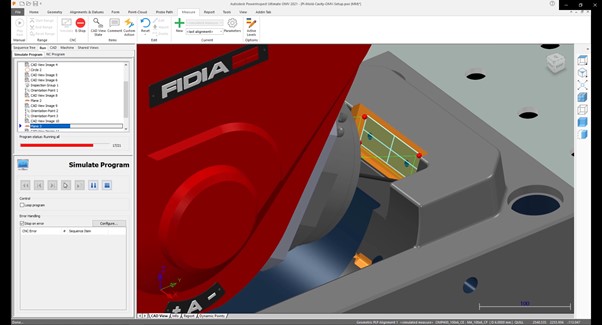
Mold Components Inspectio with PowerInspect
With this feature, manufacturing plants can optimize machining and inspection processes with many advantages such as:
- Reduce re-run time on CNC machine after testing on CMM
- Reduce load on CMMs with pre-check on CNC machine
- Products reach customers faster
- Optimizing the quality control process
Standardize your manufacturing process with Autodesk
By standardizing your manufacturing process, your company can grow with the flexibility to meet customer requirements, share workloads easily and simplify the management of complex processes. With one vendor for all your software, you can simplify daily work and adapt to change more easily. Inconsistent software interfaces, procedures and data make it harder to run efficiently, track workflows and control costs. Autodesk and its complete portfolio from design to manufacturing help your company standardize processes quickly and easily, so you can reach further goals and keep growing.